
What This Could Mean for Weapons Development in New Mexico
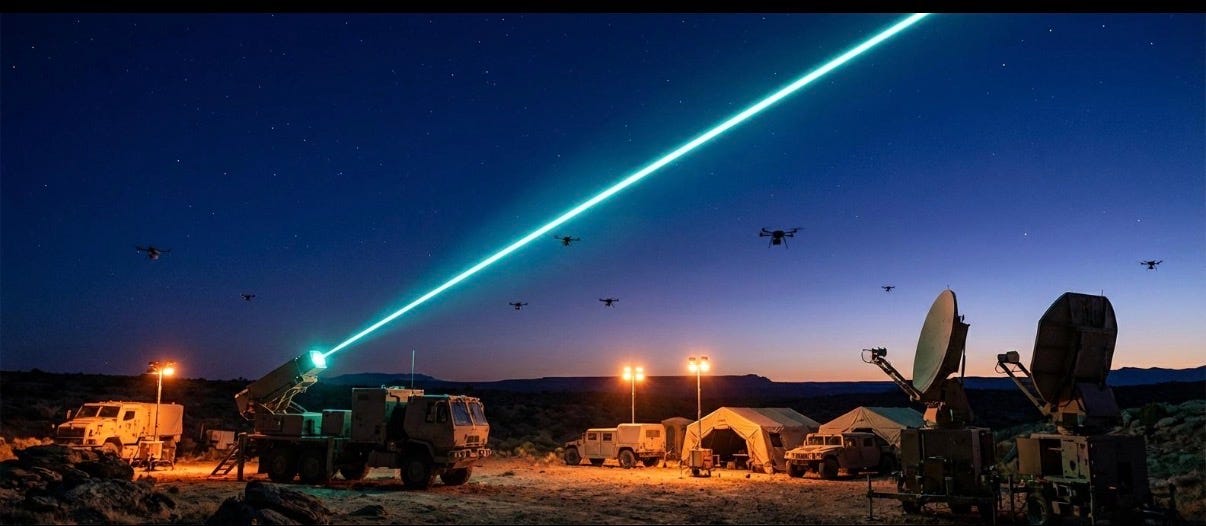
Laser testing and the Army’s expanding program.
For more than eighty years, New Mexico has served as America’s proving ground for weapons that would change warfare. The atomic bomb was born at Los Alamos. Nuclear weapons engineering became a permanent mission at Sandia National Laboratories. White Sands Missile Range evolved into one of the world’s premier test ranges for rockets, missiles, electronic warfare, and advanced military systems. What was once an isolated military landscape has become something far larger: an integrated weapons-development ecosystem where research laboratories, military installations, private corporations, venture capital, and public subsidies increasingly operate as parts of the same machine.
The Army’s decision to move high-energy laser weapons from experimental technology into a permanent “program of record” marks another turning point. It is not simply the purchase of a new weapon. It signals the beginning of sustained production, expanded testing, new supply chains, and decades of future research. Once a weapons system enters the Pentagon’s permanent budget, the question is no longer whether it works. The question becomes how rapidly it can be improved, manufactured, and deployed.
New Mexico is uniquely positioned to become one of the principal beneficiaries—and one of the principal hosts—of that expansion.
Sandia National Laboratories has spent decades advancing the science that underlies directed-energy systems: high-power lasers, pulsed power, optics, sensors, target acquisition, beam control, advanced materials, and weapons-system analysis. White Sands Missile Range provides vast restricted airspace and testing infrastructure. The Air Force Research Laboratory, Space Force operations, and nearby military installations contribute additional capabilities. Universities train engineers and scientists who feed directly into the defense workforce. Together they form an infrastructure that few places in the world can match.
The private sector is following that infrastructure. Companies developing hypersonic weapons, solid rocket motors, autonomous systems, drones, electronic warfare, and advanced manufacturing are increasingly locating in New Mexico. Public investment is helping accelerate that process. Through the State Investment Council’s Strategic Venture Capital Program, New Mexico has invested in venture-capital firms backing defense technology companies, while state and local governments simultaneously provide LEDA incentives, industrial revenue bonds, infrastructure improvements, and public land to attract those same industries.
Project Ranger illustrates this transformation. The public agreements describe the facility as a hypersonic systems test and manufacturing facility supported through state and local economic-development incentives and infrastructure improvements. It is one component of a much broader defense-industrial network that now stretches across the state.
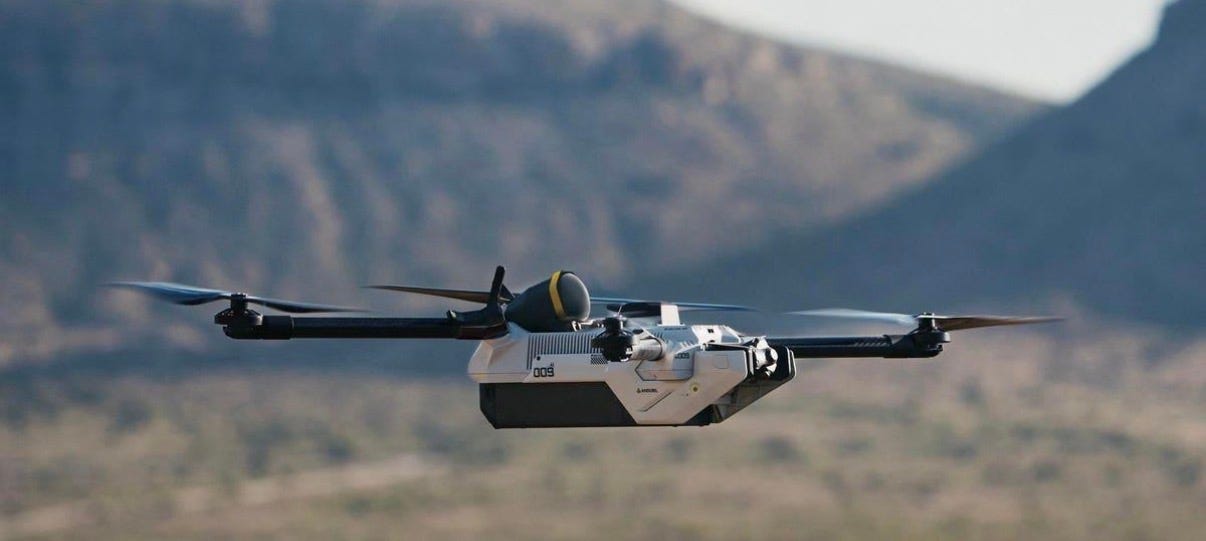
The implications extend well beyond one factory.
Modern warfare is no longer organized around individual weapons. Directed-energy weapons, autonomous drones, hypersonic missiles, artificial intelligence, electronic warfare, cyber operations, satellite systems, and advanced sensors are designed to operate together. A laser cannot function without radar, electro-optical tracking, machine vision, software, communications, and power generation. Hypersonic missiles require advanced propulsion, guidance systems, manufacturing technologies, and testing infrastructure. Every new capability strengthens the others.
New Mexico increasingly contains every link in that chain.
As directed-energy weapons become operational, testing will inevitably expand. White Sands already hosts demonstrations of laser systems designed to defeat drone swarms. Future testing will involve increasingly complex scenarios: autonomous targeting, moving aircraft, electronic warfare, coordinated drone attacks, integrated missile defenses, and artificial intelligence controlling engagement decisions. Each successful demonstration creates demand for more facilities, more contractors, more specialized suppliers, and more federal investment.
What begins as research becomes production. Production becomes permanent infrastructure.
That transformation carries consequences extending far beyond economics.
The military describes lasers as inexpensive defenses because they require electricity rather than missiles costing millions of dollars each. But the public costs are measured differently. High-energy lasers introduce new questions about airspace management, satellite safety, wildfire risk, emergency response, occupational exposure, and civilian oversight. Destroyed drones do not simply disappear; they fall. Burning batteries, fuel, debris, and fragments fall somewhere. In a drought-stricken state increasingly defined by catastrophic wildfire, those risks deserve independent analysis rather than assumptions that new technology is inherently safer because it carries no explosive warhead.
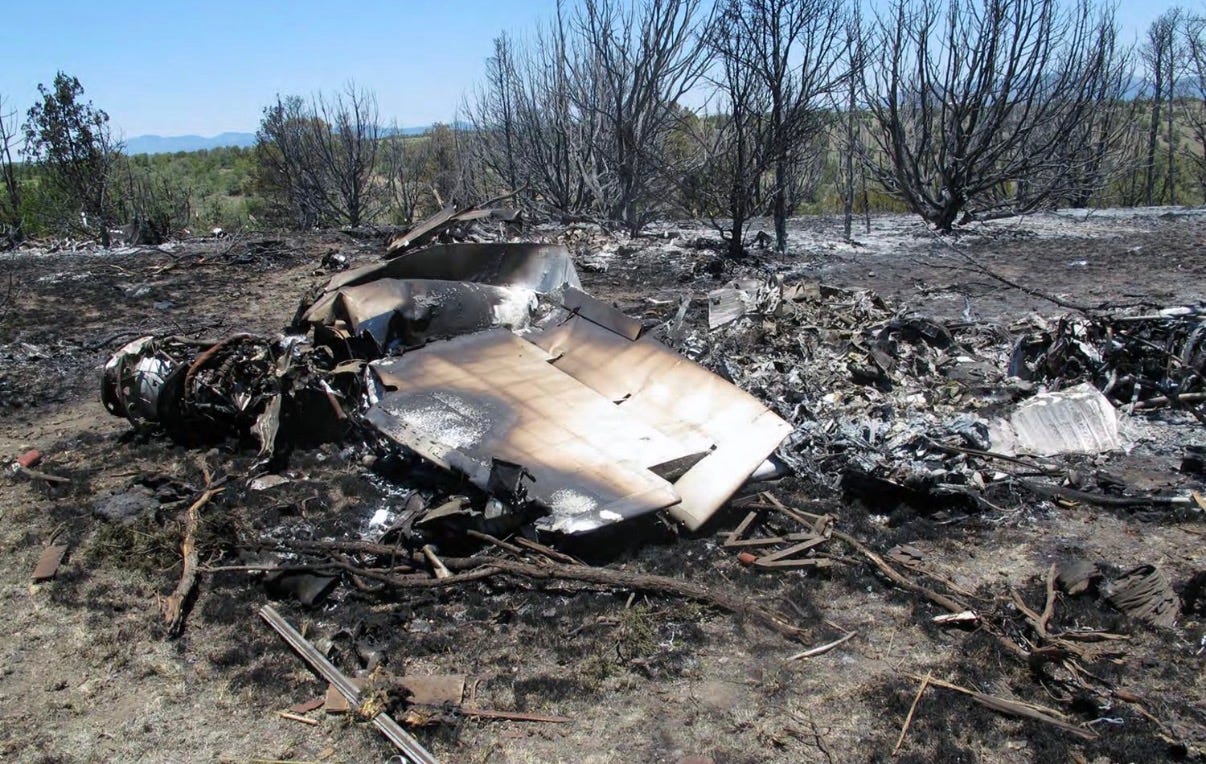
CRASH OF A BEECHCRAFT E90 KING AIR IN RUIDOSO killed 4
The four crew members who lost their lives in the May 14, 2026 Trans Aero MedEvac King Air crash in the Capitan Mountains were:
Captain Keelan Clark — Pilot, Generation Jets
Captain Ali Kawsara — Pilot, Generation Jets
Sarah Clark, RN — Flight Nurse, Trans Aero MedEvac
Jamie Novick, RN — Flight Nurse, Trans Aero MedEvac
The aircraft was flying from Roswell Air Center to Sierra Blanca Regional Airport near Ruidoso on a medical transport mission when it crashed into the Capitan Mountains shortly before dawn. The impact ignited what became the Seven Cabins Fire.
A preliminary NTSB report later documented that military GPS-jamming associated with the NAVFEST electronic warfare exercise at White Sands Missile Range was occurring in the area and that the crew experienced GPS disruption. The NTSB’s investigation remains ongoing, and a final determination of probable cause has not yet been issued.
These names deserve to be remembered. They were not test subjects or statistics—they were aviation and medical professionals serving patients when they lost their lives.
The tragedy of May 2026 should serve as a warning. Four people died when a medical aircraft crashed during military GPS-jamming operations in New Mexico. The crash ignited a wildfire that burned for weeks. Whether future systems involve electronic warfare, autonomous targeting, or directed energy, military testing no longer remains confined to distant ranges. Modern weapons increasingly interact with civilian infrastructure, civilian aviation, public communications, and shared landscapes.
Yet public oversight has not kept pace.
The same state promoting these industries increasingly occupies multiple roles simultaneously: investor, landowner, economic-development partner, regulator, infrastructure provider, and public-safety authority. Those overlapping responsibilities create unavoidable tensions. Agencies charged with protecting public health and the environment may also be expected to facilitate projects viewed as strategic economic priorities. The result is a system in which environmental review, emergency planning, and cumulative risk assessment are often fragmented among agencies, while each individual approval appears too narrow to justify broader public scrutiny.
That fragmentation is becoming one of the defining characteristics of New Mexico’s defense economy.
No single laboratory builds the entire weapon. No single company develops every component. No single permit captures the cumulative impact. Each project appears isolated. Each approval seems routine. Each subsidy is presented as economic development. Yet together they produce something much larger than the sum of their parts: an integrated military-industrial ecosystem whose expansion increasingly shapes New Mexico’s economy, public policy, infrastructure, and landscape.

The issue is no longer whether New Mexico supports defense research. That question was answered generations ago. The issue now is whether New Mexico’s citizens will have an equal voice in deciding how far that transformation should go, what risks it creates, who bears those risks, and whether public investment should continue financing industries whose environmental, public-health, and safety consequences remain only partially understood.
Directed-energy weapons represent the next chapter in military technology. Their arrival also marks the next chapter in New Mexico’s identity. The state is no longer simply a place where weapons are tested. It is becoming a place where the future architecture of warfare is researched, financed, manufactured, integrated, and normalized. Whether the public has an equal role in shaping that future remains the most important question of all.
Endnotes
1. Noah Shachtman, “Landmark Deal Would Officially Add Laser Weapons to US Army Arsenal,” WIRED, August 4, 2026. The article reports that the Army is preparing to acquire AeroVironment’s Enduring High Energy Laser, potentially purchasing as many as twenty systems. It describes E-HEL as the Army’s first laser weapon expected to become an operational “program of record,” placing it within the Pentagon’s five-year budget and signaling contractors to expand production. (WIRED)
2. The publicly identified E-HEL contractor is AeroVironment. The available evidence does not establish that Sandia National Laboratories developed E-HEL. Sandia’s documented role is part of the broader New Mexico laser, optical, satellite, counter-UAS, materials, and national-security research infrastructure. The essay should therefore describe Sandia as contributing scientific and technical capabilities relevant to directed-energy development—not as the inventor of this specific Army weapon. (WIRED)
3. Sandia National Laboratories operates the Laser Application Facility, or LAZAP, which propagates visible high-powered lasers of multiple wavelengths through the atmosphere using a large-aperture beam director. Sandia states that the facility is used to test and calibrate United States reconnaissance and GPS satellites. This documents Sandia’s high-power laser and atmospheric beam-propagation capability, although LAZAP is not publicly identified as the source of E-HEL. (Sandia National Laboratories)
4. Sandia has also published research concerning unmanned aircraft and counter-UAS technology. That work places the laboratory within the larger technical field connecting sensors, target detection, autonomous aircraft, counter-drone systems, and potential directed-energy applications. (Sandia National Laboratories)
5. White Sands Missile Range already serves as a major directed-energy testing location. The Air Force Research Laboratory reported that its Self-Protect High Energy Laser Demonstrator program successfully used a surrogate laser weapon at White Sands to shoot down multiple air-launched missiles in flight. (Air Force Research Laboratory)
6. White Sands’ Joint Directed Energy Test Center was established to support testing of high-energy lasers, high-power microwave systems, and integrated military technologies. Its environmental assessment describes testing involving directed energy, kinetic weapons, cyber operations, electronic warfare, sensors, and command-and-control systems. That combination demonstrates that modern directed-energy development is part of an integrated weapons architecture rather than a stand-alone laser program. (Army Home)
7. The Army’s environmental assessment for the Joint Directed Energy Test Center establishes controlled laser hazard areas and personnel-exclusion zones. It also recognizes that exposure of objects to a Class 4 laser presents a fire hazard. The document therefore confirms that fire, beam control, aviation safety, target placement, and range restrictions are operational concerns—not speculative objections. (Army Home)
8. The New Mexico State Investment Council’s 2025 Strategic Venture Capital Program report identifies aerospace, defense, deep technology, advanced manufacturing, and related industries as priorities of the state’s investment strategy. It documents a $35 million commitment to Crosslink funds and identifies Crosslink as a significant investor in New Mexico rocket-propulsion company X-Bow Systems. (New Mexico Secretary of State)
9. The SIC report and January 2026 announcement also identify Castelion as a Lightspeed-backed defense technology company and describe Project Ranger as a 1,000-acre solid rocket motor manufacturing campus planned for Sandoval County. This establishes an indirect relationship between New Mexico public investment capital, an SIC-supported venture manager, Castelion, and the company’s New Mexico weapons-manufacturing expansion. It does not establish that a specific SIC dollar was transferred directly to Castelion. (New Mexico Secretary of State)
10. Project Ranger’s governing Local Economic Development Act agreement identifies the project as a “hypersonic systems test and manufacturing facility.” It provides for an estimated $119.8 million corporate investment and as much as $10 million in combined state, county, and municipal LEDA support: up to $5 million from the state, $4 million from Sandoval County, and $1 million from Rio Rancho.
11. The Project Ranger participation agreement directs portions of the public assistance toward land acquisition, road expansion, infrastructure, construction costs, drainage improvements, electrical wiring, design, labor, permitting, and other facility-development expenses. The agreement also contemplates an industrial revenue bond and obligates Castelion to create employment positions tied to staged disbursements and clawback provisions.
12. The Sandoval County–Rio Rancho Intergovernmental Agreement separately identifies Project Ranger as a “hypersonic systems test and manufacturing facility” and commits $1 million in Rio Rancho LEDA funding toward expansion of Paseo del Volcan for the benefit of the project. The County is designated as the fiscal agent administering the City’s contribution.
13. The Army’s transition toward an operational laser program is connected directly to the growth of inexpensive armed drones. WIRED reports that E-HEL is intended to defend bases against one-way attack drones and that advances in fiber lasers, semiconductor diodes, machine vision, adaptive optics, and automated tracking have made deployable systems possible. (WIRED)
14. Directed-energy weapons cannot function through beam power alone. They require sensors, tracking, target classification, software, beam control, power generation, cooling, communications, and command authorization. Earlier operational laser systems have already combined precision optical hardware with artificial intelligence and software intended to support the directed-energy “kill chain.” (WIRED)
15. The New Mexico testing history shows that lasers are increasingly being integrated with conventional air and missile defense. AFRL’s White Sands testing involved engaging missiles in flight, while the Joint Directed Energy Test Center contemplates combinations of high-energy lasers, microwave weapons, sensors, electronic warfare, cyber capabilities, and conventional kinetic systems. (Air Force Research Laboratory)
16. WIRED reported serious operational failures associated with recent laser deployments. An AeroVironment system operating along the southern border reportedly struck a party balloon, contributed to a temporary airspace closure near El Paso, and later shot down a Border Patrol drone by mistake. These events demonstrate that the central safety problem is not only whether the beam can destroy an object, but whether the sensing and targeting system correctly identifies what should be attacked. (WIRED)
17. WIRED also reports that powerful laser beams may continue beyond their intended targets, creating hazards for aircraft and potentially satellites. Atmospheric conditions—including rain, fog, dust, smoke, turbulence, and water vapor—can reduce performance but do not remove the need for beam-control procedures, airspace coordination, safety zones, and defined termination areas. (WIRED)
18. On May 14, 2026, a Beechcraft King Air medical transport aircraft crashed in the Capitan Mountains near Ruidoso, killing the two pilots and two flight nurses aboard. The crash ignited the Seven Cabins Fire. (AP News)
19. The National Transportation Safety Board’s preliminary investigation documented that military GPS jamming was active in the region and that the crew reported losing GPS capability. Other aircraft also reported interference, and air-traffic controllers requested suspension of the military jamming. The NTSB has not yet issued its final probable-cause determination. The incident must therefore be described as a fatal crash occurring during documented military GPS-jamming activity—not as a crash caused by laser testing and not yet as a final legal finding that jamming was the sole cause. (AP News)
20. The Seven Cabins Fire burned for weeks in steep forested terrain, and post-fire closures remained necessary because of continuing public-safety and flooding hazards. The incident demonstrates how military interference with civilian systems can contribute to consequences extending beyond a test range, including death, fire, emergency-response demands, damaged landscapes, and long-term closure hazards. (AP News)
21. High-energy laser systems damage targets by concentrating energy until material heats, weakens, burns, melts, or ruptures. The resulting wildfire danger includes more than direct beam contact with vegetation. A successful engagement may produce burning lithium batteries, ignited fuel, hot fragments, damaged energetic components, and falling drone debris. White Sands’ environmental assessment acknowledges the underlying fire hazard and requires range controls intended to contain it. (Army Home)
22. No Project Ranger agreement reviewed here states that the facility will manufacture, test, install, or operate directed-energy weapons. The documented project is a hypersonic systems test and manufacturing facility supported by public land, public financing, and infrastructure. Any assertion that Project Ranger will conduct laser-weapons testing would require additional evidence, such as equipment inventories, building plans, military contracts, environmental reviews, fire-code submissions, or company disclosures.
23. The defensible connection between directed energy and Project Ranger is systemic rather than contractual. Sandia provides laboratory and technical capacity; White Sands provides large-scale weapons testing; private contractors produce laser, drone, missile, propulsion, sensing, and targeting systems; and New Mexico’s investment and economic-development agencies use public capital and incentives to attract defense manufacturing. The available sources show the components of this network even though they do not establish that every institution or company is working under one contract or on one weapon. (Sandia National Laboratories)
24. The cumulative public-policy issue is the state’s simultaneous role as investor, promoter, land and infrastructure provider, and regulator. This conclusion is an inference drawn from the SIC investment documents, the Project Ranger LEDA agreements, and New Mexico’s concentration of federal weapons research and testing institutions. The sources document the separate roles; the institutional-conflict analysis is the author’s conclusion based upon their convergence. (New Mexico Secretary of State)